
Favero Assioma PRO RS-2 vs. Assioma DUO: Podless Spindle Architecture, IAV Metrology, PCO Telemetry & Buyer Decision Guide
Engineering comparison of the Favero Assioma PRO RS-2 and Assioma DUO: podless spindle design, IAV power math, PCO support, battery life, and validation research.
SportsTech Research Desk
Sensor & kinetics research
A pedal-based power meter sits at the one place where the rider’s force is actually delivered to the bicycle: the cleat-pedal interface. That is a physically honest measurement point, but it is also a hostile one. The sensor lives in a sealed, rotating, shock-loaded, wet and thermally unstable environment, and it has to resolve a few newton-meters of bending strain against a background of heat, vibration and cadence-dependent noise.
Favero’s Assioma DUO (launched 2017, Look KEO interface) and the newer Assioma PRO RS-2 (native Shimano SPD-SL interface) are two answers to the same metrology problem with very different mechanical packaging. The DUO carries its electronics in an external pod beside the crank arm. The PRO RS-2 moves everything into a hollow, resin-potted spindle and drops the pod entirely.
This is a first-principles biomechanical and sensor-architecture analysis built on manufacturer documentation and peer-reviewed literature. It involved no in-house laboratory testing by SportsTech Consulting. Where we reason beyond published figures, we say so.
1. Architecture: External Pod vs. Podless Spindle
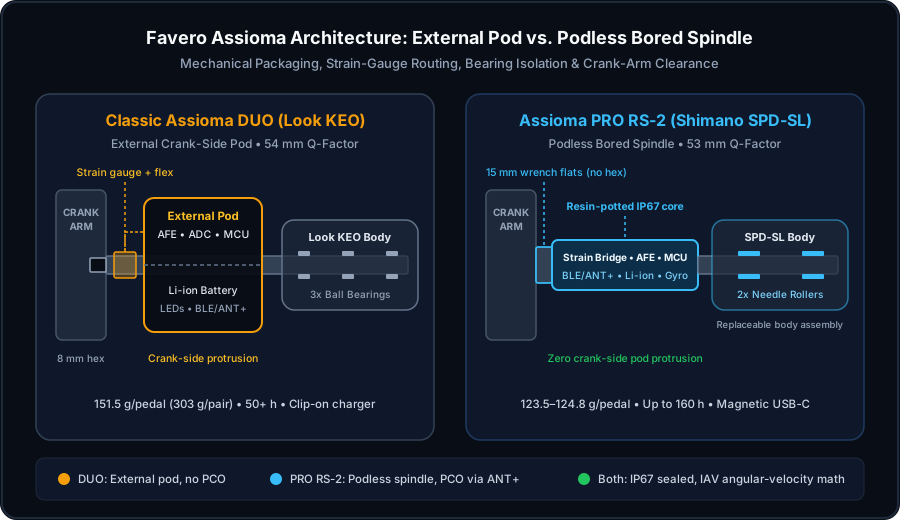
In the DUO, the strain-gauge array is bonded to the spindle neck near the crank shoulder, and a flexible circuit routes signals to the pod, which houses the analog front end, ADC, microcontroller and battery. The pod is a practical design, but it adds mass, adds a crank-side protrusion, and can contact the shoe or certain crank profiles.
The PRO RS-2 packs the same functional blocks into a bored spindle: bridge, signal chain, radio, battery and an inertial sensor, then potting the cavity in resin. Favero’s published documentation describes an IP67 sealed design. Our reading of the geometry is that potting also helps thermal uniformity across the bridge, which is an analytical inference rather than a published Favero claim.
Spec and Architecture Comparison
| Parameter | Assioma DUO | Assioma PRO RS-2 |
|---|---|---|
| Cleat interface | Look KEO | Shimano SPD-SL (native) |
| Electronics location | External pod at crank | Integrated in spindle (podless) |
| Pedal mass | 151.5 g per pedal (303 g per pair) | 123.5–124.8 g per pedal (~247–250 g per pair) |
| Q-factor | 54 mm | 53 mm |
| Bearings | 3x sealed cartridge ball bearings | 2x needle roller bearings in the replaceable pedal body |
| Installation tool | 8 mm hex key | 15 mm pedal spanner (no hex socket, due to internal spindle electronics) |
| Battery runtime | 50 hours or more | 60+ hours at launch; up to 160 hours after Favero’s February 2026 firmware update |
| Charging | Dual clip-on magnetic charger | Magnetic USB-C charging |
| Platform Center Offset (PCO) | Not supported | Supported via ANT+ and the Favero Assioma app |
| Ingress protection | IP67 | IP67 |
| Indicative MSRP | ~$759 MSRP | ~$799 MSRP |
Two details deserve engineering comment. First, the 15 mm spanner requirement on the RS-2 is a direct consequence of the electronics: without a hex socket at the spindle end, the pedal cannot be installed with an 8 mm key, so carry the right tool. Second, the RS-2’s needle roller bearings sit in the replaceable pedal body, so the wearing bearing set and the metrology spindle are separate assemblies. The DUO’s three sealed cartridge ball bearings are the more conventional arrangement.
2. Metrology: Strain Gauges, Torque and Instantaneous Angular Velocity
Mechanical power is torque multiplied by angular velocity:
P(t) = torque(t) x omega(t)A pedal measures force through strain: a Wheatstone bridge converts tiny resistance changes in the foil gauges, proportional to strain, into a voltage the ADC can read. The harder part is the second term. Many power meters estimate angular velocity as an average over one crank revolution:
omega_avg = 2 x pi / T_revolutionWithin a revolution, however, crank angular velocity is not constant. It varies with the pedal stroke, and varies more with non-circular chainrings, sprints and steep climbs. Because torque is highest in the drive phase, pairing peak torque with an average angular velocity can bias the result. How large that bias is depends on the rider and equipment, and we are not aware of a single authoritative figure, so we do not quote one.
Both Assioma generations use Instantaneous Angular Velocity (IAV). A gyroscope samples crank rotation continuously, and the firmware pairs each torque sample with the matching angular-velocity sample:
P_avg = (1/K) x sum over k of [ torque_k x omega_k ]This is why the manufacturer positions both products as insensitive to chainring shape and cadence surges. The shared metrology matters for the buying decision: the measurement engine is not what separates these two pedals. The mechanical package, ecosystem and data fields do.
Temperature and Zero Offset
Strain-gauge resistance and steel stiffness both change with temperature, so a bridge that is zeroed in a warm garage will drift on a cold descent. Both pedals include an onboard temperature sensor and apply compensation across the manufacturer’s stated operating range. Practical advice is unchanged between generations: let the pedals reach ambient temperature, then zero-offset with the crank hanging free before an important test ride.
3. Peer-Reviewed Validation Literature
Important scope note: every study below evaluated the Classic Assioma DUO hardware, not the PRO RS-2. We cite them because the two products share the same IAV and strain-gauge metrology approach. That is a reasonable engineering argument for carry-over, but it is not equivalent to a dedicated RS-2 validation, and we do not present it as one.
- Montalvo-Pérez et al. (2021), Sensors 21(7):2277. Validity of the Assioma Duo for power and cadence against a reference crankset. DOI: 10.3390/s21072277
- Rodríguez-Rielves et al. (2021), Sensors 21(8):2789. Reliability of the Assioma pedals for monitoring cycling power output. DOI: 10.3390/s21082789
- Bouzigues et al. (IJSPP, ahead of print). Accuracy, reproducibility and sensitivity of the Assioma Duo against an SRM reference. Of particular note, this work reports a tendency to overestimate power below 100 W. DOI: 10.1123/ijspp.2025-0323
- Valenzuela et al. (2021), IJSPP. Examines whether unilateral devices are valid for power determination, using Assioma data to show why single-sided doubling is a compromise for riders with variable left/right balance. DOI: 10.1123/ijspp.2021-0278
What to take from this. The DUO’s general validity against laboratory reference systems is well supported. The low-power overestimation finding is relevant for recovery riding, warm-ups and anyone using very low-wattage data for decoupling or drift analysis: treat sub-100 W numbers with extra caution. If you buy the RS-2, you are relying on shared metrology rather than RS-2-specific validation. Check the literature again over time, as dedicated RS-2 work may appear.
4. Telemetry and Cycling Dynamics: Where the Pedals Actually Differ
Both pedals broadcast over ANT+ and Bluetooth Low Energy, and both provide dual-sided power, cadence and left/right balance, which is the foundation of useful pedal-based biomechanics.
The meaningful difference is Platform Center Offset (PCO).
- PCO describes where on the pedal platform the net force is applied, relative to the platform center. It is a window into foot position and force-application stability across the stroke.
- Assioma PRO RS-2: measures and transmits PCO via ANT+ to compatible head units, such as Garmin Edge computers paired over ANT+, and shows it in the Favero Assioma app.
- Classic Assioma DUO: does not support PCO.
For riders who care about fit, cleat position, and understanding how force is applied across the platform, this is the single most decision-relevant data difference between the two products. It does not change the headline power number. It changes what else you can learn from a ride.
Whether any specific PCO trace reflects meaningful performance or injury risk is a separate question. As with most pedal dynamics fields, interpretation should be conservative and trend-based, and validated against professional bike-fit assessment rather than used on its own.
5. Cleat Ecosystem: RS-2, RL-2 and the Older DUO-Shi Adapter
- Assioma PRO RS-2: native Shimano SPD-SL pedal body with a 53 mm Q-factor.
- Assioma PRO RL-2 (March 2026): the podless Look KEO counterpart on the same platform. If you want the PRO architecture and your cleat standard is Look KEO, look at the RL-2 rather than defaulting to the DUO.
- DUO-Shi: an older adapter that put the DUO spindle into a Shimano-style pedal arrangement, at roughly a 65 mm Q-factor. Do not equate this with the RS-2. The RS-2 is a native pedal at 53 mm, a 12 mm narrower stance, which is large in fit terms and relevant to knee tracking and hip width.
6. Mid-Article Buyer Decision
If you want a quick rule: Shimano SPD-SL users who want PCO, lower mass and a cleaner crank-side profile should lean RS-2. Look KEO users who do not need PCO and want the lower price should lean DUO.
7. Battery, Weight and Day-to-Day Ownership
Battery. The RS-2 launched at 60+ hours and, after Favero’s February 2026 firmware update, is specified at up to 160 hours using magnetic USB-C charging. The DUO is rated at 50 hours or more and uses a dual-clip magnetic charger. For high-volume riders, the RS-2’s longer runtime means far fewer charging events over a season, and a single USB-C cable is easier to travel with.
Mass. The RS-2 saves roughly 28 g per pedal (123.5–124.8 g vs. 151.5 g), about 53–56 g per pair. That is real in rotating mass terms but small relative to system mass, so we treat it as a minor performance factor and a more meaningful clearance and aesthetics factor.
Maintenance. The RS-2’s replaceable pedal body helps with long-term serviceability and makes cleat-standard changes more practical across the platform. The DUO’s pod is simple but can be exposed to shoe contact on tight crank profiles.
8. Ecosystem Integration
Pedal power is rarely used alone. Pair it with a head unit that actually exposes the fields you care about. A Wahoo ELEMNT BOLT V3 or a Garmin Edge covers the basics; for PCO on the RS-2 over ANT+, check your head unit’s supported fields first.
Cross-discipline athletes can put pedal power next to other data streams. For running power, see our Stryd Duo biomechanics review. For cardiac data to pair with wattage, see our Polar H10 vs. Garmin HRM-Pro Plus comparison.
9. Limitations of This Analysis
- No in-house laboratory testing was performed. Everything here is derived from manufacturer documentation and peer-reviewed literature.
- All cited validation studies evaluated the Classic Assioma DUO. RS-2 accuracy is inferred from shared metrology, not independently confirmed.
- Specifications such as runtime and mass come from manufacturer-stated figures and may change with firmware or production revisions. Verify before purchase.
- Prices are indicative MSRP figures only and change by retailer and region.
10. Final Verdict
| Rider profile | Pick | Why |
|---|---|---|
| Shimano SPD-SL, wants PCO and a clean crank profile | Assioma PRO RS-2 | Native 53 mm Q-factor, podless, lighter, longer runtime, PCO via ANT+ |
| Look KEO, wants the lowest cost of entry | Assioma DUO | Same IAV and strain-gauge approach, widest peer-reviewed validation record |
| Look KEO, wants podless PRO architecture | Assioma PRO RL-2 | Same platform as RS-2 in a KEO interface (March 2026) |
The honest summary: the power accuracy story is shared, and the DUO has the stronger direct validation record. The RS-2 wins on integration, mass, battery runtime and PCO. If those matter to you and you ride Shimano cleats, the premium of roughly $40 MSRP is modest. If they do not, the DUO remains a mature, well-studied choice.
Published by SportTechConsulting Research Lab.