
Upper-Arm PPG vs. Budget ECG Chest Straps: Latency, Motion Artifact & R-R Validity for Endurance Athletes
Engineering comparison of upper-arm optical PPG (COROS, Polar Verity Sense) against ECG chest straps (Garmin HRM 200, Wahoo TRACKR, COOSPO H808S), with DOI-backed evidence.
SportsTech Research Desk
Sensor & kinetics research
Bottom line: For true R-R intervals and HRV work, buy an ECG chest strap. For comfort, swimming, and strong heart-rate tracking during hard intervals without a belt around your ribs, buy an upper-arm optical band. Either way, skip the wrist for interval work.
Wrist optical sensors are good enough for all-day heart rate and poor at the thing endurance athletes actually need them for: short, hard intervals, cold mornings and stride-locked running. This article compares the two credible alternatives. One is the upper-arm optical band (COROS Heart Rate Monitor, Polar Verity Sense). The other is the ECG chest strap, covering the Garmin HRM 200, Wahoo TRACKR Heart Rate and COOSPO H808S, with the Polar H10 and Garmin HRM-Pro Plus as reference anchors.
Methodology. This is a first-principles physics and sensor-architecture analysis by SportTechConsulting Research Lab, built on manufacturer specifications and peer-reviewed literature. SportsTech Consulting did no in-house laboratory testing. Where we reason beyond published data, we label it as inference.
For the flagship comparison of the two reference straps, see Polar H10 vs. Garmin HRM-Pro Plus. For the watch-side picture, see our best endurance smartwatches of 2026 guide.
1. Two Different Physical Measurements
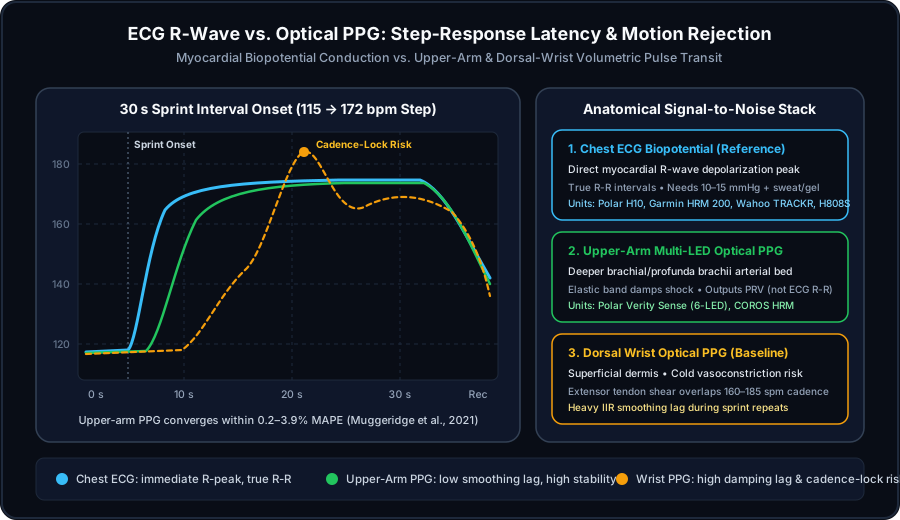
ECG measures the electrical depolarization of the ventricles through electrodes on the chest. The R-wave is a direct electrical event, so beat timing carries essentially no physiological transit delay and R-R intervals are real inter-beat intervals.
PPG shines light into tissue and watches blood-volume changes in the microvasculature. That signal is downstream of the heart: the pressure pulse must travel along the arterial tree, and then the firmware has to filter motion noise out of a weak optical waveform. Two consequences follow:
- Transit delay. The pulse reaches the upper arm sooner than the wrist because the path is shorter. The exact delay varies by person and vascular state.
- Filter delay. Motion-cancelling filters smooth the waveform, which adds a lag of seconds. In our analytical view this lag is the larger term, and it is larger for wrist devices that need heavier filtering.
Optical devices also output pulse rate variability (PRV), not electrical HRV. At rest the two agree reasonably well, but during hard exercise pulse-transit changes can decouple pulse timing from R-wave timing. If you do HRV or DFA alpha-1 work during exercise, chest ECG is the right instrument.
2. Why the Upper Arm Beats the Wrist
- Perfusion. The wrist’s distal skin bed is prone to vasoconstriction in cold and early exercise, shrinking the pulsatile signal. The upper arm sits over a muscular bed with stronger perfusion.
- Tendon motion. Gripping handlebars or pumping the arms moves extensor tendons directly under a wrist sensor. A biceps-mounted band avoids that.
- Cadence lock. Running cadence (roughly 160–185 steps per minute) overlaps the heart-rate band. A wrist sensor’s tracking filter can latch onto stride frequency and report cadence as heart rate. The upper arm is mechanically damped by the forearm and elbow, which reduces the problem.
- Strap compression. An elastic band holds the optics against muscle, which stabilizes skin coupling.
What the Literature Says
Study scope matters here: these papers tested specific devices, namely the Polar OH1 and Polar Verity Sense, which are upper-arm optical sensors. They do not validate every armband.
- Muggeridge et al. (2021), JMIR mHealth and uHealth: the upper-arm optical sensor produced a mean absolute percentage error of roughly 0.2–1.9% on the treadmill and 0.6–3.9% in cycling, and held its validity during sprint-based exercise where the wrist-worn PPG device did not. DOI: 10.2196/25313
- Hermand et al. (2019), International Journal of Sports Medicine: validation of the Polar OH1 found an ICC of 0.99, over 99% reliability across endurance exercise, and Bland-Altman differences under 5%. DOI: 10.1055/a-0875-4033
- Liu et al. (2025), Journal of Sports Sciences: evaluated the Polar Verity Sense during high-intensity interval exercise in adolescents, supporting its use in variable-intensity protocols. We reference the paper for its scope and do not restate effect sizes here. DOI: 10.1080/02640414.2025.2491163
3. ECG Chest Straps: Where Budget Hardware Can Fail
An ECG strap needs two things from the skin: low, balanced electrode impedance, and constant mechanical contact.
Impedance and hydration. Wiese et al. (2005) studied ECG motion artifact against electrode impedance. They found that dried electrodes, with higher impedance, increased missed QRS detections. They also found that static impedance correlated poorly with motion-artifact noise. In practice, wetting the electrodes helps detection, but low static impedance alone does not guarantee a clean signal during motion. DOI: 10.1109/TBME.2004.836503
Contact mechanics. That is why Comert et al. (2013) matter. Their work on textile electrodes shows that pressure and padding strongly influence motion artifact, and puts the useful contact pressure in the 10–15 mmHg range. DOI: 10.1186/1475-925X-12-26 The practical translation: strap tension and fit matter at least as much as how wet the pods are. A loose strap on a deep-breathing runner moves, and the signal degrades.
R-R quality. Gilgen-Ammann et al. (2019) assessed R-R interval signal quality for a chest-strap monitor (Polar H10) against a Holter ECG at rest and during exercise, supporting chest-strap R-R data as a practical surrogate for research-grade ECG. This evidence concerns the H10, a reference anchor, not the budget straps below. DOI: 10.1007/s00421-019-04142-5
Inference on budget straps. We have no published validation of the COOSPO H808S R-R quality, and we do not claim it performs poorly. As a first-principles matter, cheaper pods and straps leave less margin on electrode material, strap conformity and firmware peak detection, so dry-skin starts and loose fits are where we would expect problems to show up first.
4. Spec Matrix
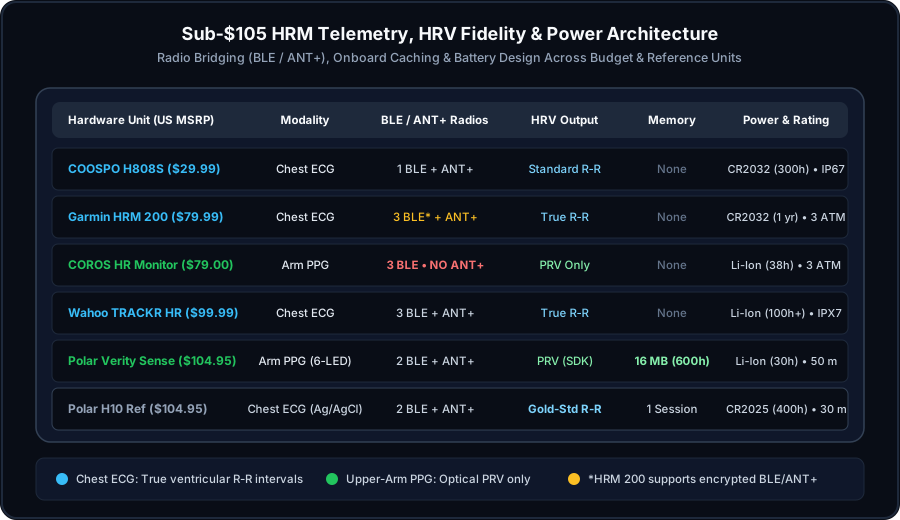
| Unit | Sensing | BLE channels | ANT+ | Memory | Power | Water | Weight | MSRP |
|---|---|---|---|---|---|---|---|---|
| COROS Heart Rate Monitor | Optical PPG (upper arm) | 3 | No | None (PRV only) | Li-Ion, 38 hrs | 3 ATM | 19 g | $79 |
| Polar Verity Sense | 6-LED optical PPG | 2 | Yes | 16 MB (~600 hrs) | Rechargeable | 50 m (swim) | 19 g (5 g pod) | $104.95 |
| Garmin HRM 200 | ECG | 3 (open and encrypted) | Yes | None | CR2032, up to 1 year at 1 hr/day | 3 ATM (30 m) | 63 g (20 g module, M-XL strap) | $79.99 |
| Wahoo TRACKR Heart Rate | ECG | 3 | Yes | None | Li-Ion, 100+ hrs | IPX7 | 39 g | $99.99 |
| COOSPO H808S | ECG | 1 | Yes | None | CR2032, 300 hrs | IP67 | 46 g | $29.99 |
| Polar H10 (reference) | ECG | 2 | Yes | Single session | CR2025 | 30 m | n/a | $104.95 |
| Garmin HRM-Pro Plus (reference) | ECG | 3 | Yes | Yes | CR2032 | 5 ATM | n/a | $129.99 |
Prices are baseline MSRP figures only, and street prices vary by retailer.
5. Unit Breakdowns
COROS Heart Rate Monitor
A 19 g upper-arm band with three concurrent BLE connections and a 38-hour Li-Ion battery. It has no ANT+ radio, no onboard memory and outputs PRV only. That makes it a good choice for BLE-first ecosystems (phones, COROS watches, many head units), and a poor one for an ANT+-only device.
Check COROS Heart Rate Monitor →Polar Verity Sense
The most capable optical unit here: six LEDs, two BLE connections plus ANT+, and 16 MB of onboard memory (about 600 hours) for recording without a phone or watch. It is rated to 50 m for swimming and weighs 19 g in total, with a 5 g pod. It is the pick for swimmers and multisport athletes.
Check Polar Verity Sense →Garmin HRM 200
An ECG strap with a 20 g module, 63 g total with the M-XL strap, and a 3 ATM (30 m) water rating. It supports open and encrypted BLE across three channels, plus ANT+. A replaceable CR2032 gives up to a year at one hour a day. It has no onboard workout memory, so it is a live-telemetry sensor only.
Check Garmin HRM 200 →Wahoo TRACKR Heart Rate
A 39 g rechargeable strap with 100+ hours of runtime, IPX7, three BLE channels and ANT+. No onboard memory. It is the easy choice for people who dislike coin cells, though IPX7 is not a swimming rating.
Check Wahoo TRACKR Heart Rate →COOSPO H808S
The budget ECG option at $29.99 MSRP: 46 g, CR2032 with 300 hours, IP67, ANT+ and a single BLE connection. No memory. The single BLE slot is the limitation: if you want a watch and an app listening at once, you need ANT+ on one of them. Use proper strap tension, per the contact-mechanics point above.
Check COOSPO H808S →6. Which One Should You Buy?
- HRV, DFA alpha-1 or R-R analysis: an ECG strap. The Garmin HRM 200 and Wahoo TRACKR are the practical picks. The Polar H10 is the sports-science reference.
- Comfort, ultra-distance, or you dislike belts: COROS Heart Rate Monitor or Polar Verity Sense.
- Swimming or standalone recording: Polar Verity Sense.
- ANT+ head unit: anything except the COROS.
- Tightest budget: COOSPO H808S, tensioned correctly.
Limits of this analysis. No in-house lab testing was done. Several papers validate predecessor or sibling devices (Polar OH1, Polar H10), not every product here. Specifications are manufacturer-stated and can change.
Final Buying Decision
Reference anchors: Polar H10 and Garmin HRM-Pro Plus.
Published by SportTechConsulting Research Lab.